Friday, August 29, 2014

Epilogue: Our future in space (post 70)


EPILOGUE: In 1969 President Nixon appointed a Space Task Group, headed by Vice President Agnew, which concluded that the U.S. could land on Mars by as early as 1981 with sufficient political and financial support. Now in 2014, 45 years after I covered the Apollo 11 launch, NASA is still talking 20 years away for a Mars mission; a return to the Moon is not being seriously considered. What are the ingredients for a recipe for an aggressive U.S. space program?  Briefly: 1) An external threat, whether an errant asteroid or an aggressive China. 2) Strong presidential leadership in favor of space, similar to that of Presidents Kennedy and Johnson. 3) A supportive Congress with bipartisan  backing of NASA. 4) Multi-year funding for complicated missions which are hamstrung by the vagaries of yearly appropriations. 5) Congress leaving technical decisions to NASA instead of trying to micromanage like the Alabama and Florida delegations. 6) A NASA leadership which is not afraid to take risks by making bold decisions, such as LOR and flying Apollo 8 around the Moon.7) NASA program managers who are held truly accountable for budgets and performance,  and who hold contractors to the same level of accountability. 8) A change in NASA culture where there is good communications at all levels-- where individuals feel empowered to speak out about engineering, budget, or other problems. 9) A reduction in unnecessary program requirements and paperwork so as not to stifle initiative and slow progress to a crawl. 10) And most importantly, clearly announced goals for the space program with fixed targets--and not “we may got to Mars by the mid-2030’s.” It has been a joy for me to follow the space program since the 1950’s and the high point for me so far  was covering Apollo 11. Mankind’s future is in space and I hope to be around a while longer to be an eyewitness.
#Apollo11Eyewitness  Post #70 (END)
http://apollo11eyewitness-chudwin.blogspot.com/

Wednesday, August 27, 2014

Spaceflight 2013 cover story (post 69)


Positive comments about my 2009 on-line collectSpace posts and Astrophile article concerning my Apollo 11 experiences convinced me that there was interest in the story of  how I covered the Apollo 11 launch as a 19 year-old college journalist. My color slide photos received a special warm reception because they were so different from the classic NASA images for Apollo 11, especially  how they had maintained their color and clarity over more than 4 decades. It took a while, but I finished a longer article based on my previous writings. Titled “Apollo 11: Eyewitness to History,” it appeared in the January, 2013 issue of Spaceflight (pgs. 26-29, vol. 55, no. 1), with one of my Saturn V photos as the cover picture. For the 45th Anniversary of Apollo 11 this year,  I decided to post some of the pictures on Facebook. This modest undertaking evolved into the 69 posts (only one more to go!) on Space Hipsters and a new blog which you have been reading. A number of you have suggested a book so I plan to explore my options over then next couple years. The Fiftieth Anniversary of Apollo 11 in 2019 would be an appropriate year for publication—stay tuned!

#Apollo11Eyewitness  Post #69


Tuesday, August 26, 2014

Remembering and writing about Apollo 11 (post 68)


The years went by, yet my excitement about my 1969 experiences at the Apollo 11 walkout, launch and parade did not diminish. Indeed, my enthusiasm for space exploration increased as the decades passed. It took me a while for me to realize that both my story and photographs were somewhat unique—my friend and I were the only college reporters accredited by NASA to cover the First Landing on the Moon, and we were among the youngest of the 3,500 journalists privileged to cover that epic event. th Anniversary approached in 2009, I decided it was time to write about my adventures. For the collectSpace website, founded and edited by the wonderful Robert Pearlman, I prepared a series of on-line posts presenting an edited version of my 1969 diary (http://www.collectspace.com/ubb/Forum29/HTML/000960.html) For the astrophilatelic Space Unit’s journal the Astrophile, I summarized my journey and dovetailed  it with  the story of space artist Paul Calle, who was featured in the issue (pgs. 158-63, vol. 54, no. 2, May-August 2009) . Paul was inside the MSOB sketching the crew as they suited up while I was just outside the same building waiting for them to walkout on July 16, 1969. These two articles had a limited audience, however, and I later decided to expand my horizons.


As the 40

#Apollo11Eyewitness  Post #68


Saturday, August 23, 2014

Neil Armstrong 40 years later (post 67)


The next time I again saw Neil Armstrong in person was 40 years later in 2009. By then Armstrong had achieved almost mythic status and was only making a limited number of public appearances. I was at the Apollo 12 40th Anniversary dinner, sponsored by the worthy Astronaut Scholarship Foundation (ASF), when he arrived surrounded by security men wearing ear plugs. I began to understand the reason when he was literally mobbed by well-wishers seeking a photo with him or to say hello (it was well-known he had stopped giving autographs). My hopes for a personal picture with Armstrong were dashed, but I was able to get some close-up shots of him. However, when ASF put on-line the photos from the event, I was thrilled to find a photograph showing Neil at his table (with Gene Cernan and Charlie Bolden) with me lurking in the background at upper right behind Alan Bean! So while I never had a formal picture taken with Neil, there is at least this one photo with both of us in the same frame. (I also saw him from a distance at the Apollo 13 40th Anniversary dinner at the Adler Planetarium in 2010). No one could have been a better choice for First Man than Neil Armstrong. He was a brilliant pilot, an intellectual fascinated by the intricacies of subjects ranging from aeronautical engineering to chronometers, a quiet man who conducted himself with dignity but who was also comfortable with who he was. While some criticized him for not being more of a cheerleader for space, Armstrong did serve as vice-chairman of the commission investigating the Challenger disaster and made appearances before Congress on the future of space. Neil Armstrong’s name will be remembered for thousands of years; I feel privileged to have seen him in person as he walked out in his spacesuit to fly to the Moon.

#Apollo11Eyewitness  Post #67
http://apollo11eyewitness-chudwin.blogspot.com/


Friday, August 22, 2014

Meeting Mike Collins 40 years later (post 66)


Michael Collins has led an active life after Apollo 11 but has avoided most public events in recent years (except meeting the President every 5 years on the anniversary of Apollo 11). One of his greatest achievements was overseeing the construction and opening of the popular National Air & Space Museum on time and on budget as its Founding Director. He is also an accomplished writer whose “Carrying the Fire” is widely acclaimed one of the best astronaut biographies. In later years he has taken up water color art. As a favor to fellow artist Kim Poor, Collins and his late wife Pat did appear at Spacefest 2 in San Diego in 2009. I had a chance to meet him there. I introduced myself and, to my astonishment, he said, “I know who you are.” It turns out that he was an anonymous member of the Space Unit astrophilatelic group in the 1980’s when I was editor of its newsletter, the Astrophile. I saw him again at the reception and dinner. Collins in many ways is a renaissance man—test pilot, astronaut, writer, museum director, and artist. If I could have lunch with any astronaut, past or present, Mike Collins would be my first choice.


#Apollo11Eyewitness  Post #66


Wednesday, August 20, 2014

Meeting Buzz Aldrin years later (post 65)


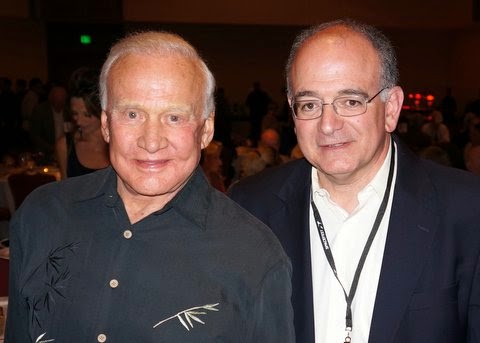
I saw the  entire Apollo 11 crew twice in person in 1969, first during their walkout on the way to the Moon, and then again during their triumphant parade in Chicago the next month. It would be 40 years, however, until I saw all three again. I have had the pleasure of meeting Buzz Aldrin at a number of space events from 2005 through this May at Spacefest 6. Of the Apollo 11 crew, Aldrin is the most gregarious and publicly active. While he can be abrupt, rude and and even greedy at times (the “bad Buzz”), he is more often genial, approachable, and friendly (the “good Buzz”). He has been a tireless advocate for the future of space exploration, championing advanced technology to get us to Mars and beyond. While critics have denounced some of his activities as tasteless (“Dancing with the Stars”), no one can deny Buzz’s energy, intelligence, and his passion for the future. At age 84 he has barely slowed down. 

#Apollo11Eyewitness  Post #65


Monday, August 18, 2014

NASA managers leading Project Apollo (post 64)


Besides the astronauts and Flight Controllers, another key group of  people responsible for the success of Apollo 11 were the NASA leaders and managers who directed this complex effort.  In the year following Apollo 11, I wrote many of NASA’s  top brass to congratulate them on their achievement and to seek their autographs on identical First Man on the Moon stamp First Day Covers. Among others, at NASA Headquarters I wrote to NASA Administrator Tom Paine, Apollo Program Director Gen. Sam Phillips and Apollo 11 Mission Director George Hage.  I wrote to Director Robert Gilruth, Deputy Director Chris Kraft and Apollo Spacecraft Program Manager George Low at the Manned Spacecraft Center. At the Kennedy Space Center I wrote to Director Kurt Debus and Director of Launch Operations Rocco Petrone. (Notable absences from this group of signed covers are George Mueller, Associate Administrator for Manned Spaceflight, and Wernher von Braun, MSFC Director.) Each of these brilliant men played key, but different, roles in organizing the Apollo program to successfully land and return from the Moon.

#Apollo11Eyewitness  Post #64